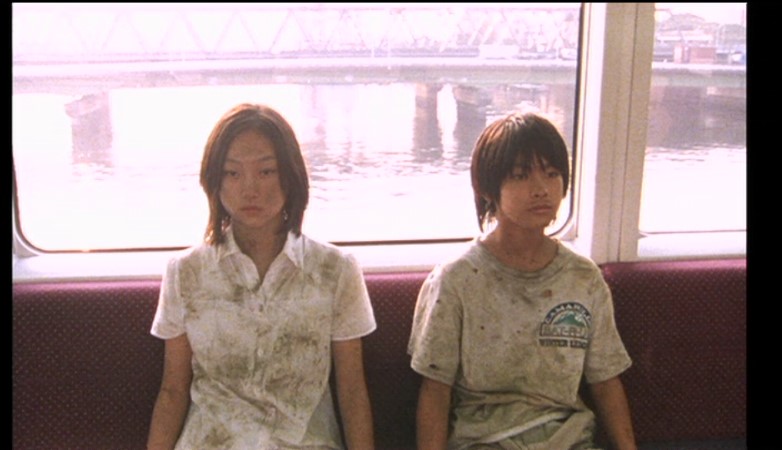
What makes someone a parent? Is it the fact that one is able to produce an offspring or is it something more than that? Nobody Knows (2004) try to explore the answer to that question and at the same time tries to show the stark reality of the effects of child abandonment in society and how it greatly takes away a big part of a child's life.
Based on a real life incident that happened in Japan, Nobody Knows is a story of the survival of four children after their irresponsible mother abandoned them. They are left to live on their own with the little amount of money that their mother left as she runs off and marry another guy.
Picture not mine. Click here for the original source.
It starts when a mother and son (12 years old) moves into a new apartment with their bulky baggage. As the door closes, two children pops out of the huge luggage while another one is rendezvoused at the train station and is stealthily sneaked in by her big brother. The mother then tells her children that they are not allowed to go out of the room and play nor go to school. She goes off after a few day leaving the eldest son, Akira, in charge with 50,000 yen which he is supposed to budget for the rest of the days until she is back. When cash was running out, Akira tries to ask for help from the fathers of his sibling but the attempt was futile. He was able to get 5000 yen from them and that's it. Fortunately, their mother comes back bringing presents for them. She leaves the next day never to return again, leaving the four children on their own devices.
It does not give you a resolution. It is merely a recounting of an unfortunate incident that befell four kids who are too unlucky to be born to useless parents who think that parenthood is nothing but a childish game they can leave anytime they want to.
Picture not mine.
Click here for the original source.
It surprises me that despite the movie's haunting theme and plot, I was numb after watching it. Usually, I would cry my heart out because of how cruel the world is to these kids but I guess it was the intention of the director to distance the viewer from the emotions, make it as stoic as possible, because the alternate option will absolutely be heart-crushing that one cannot help but question the morals of society and be jaded for the rest of his/her life. The scarier fact about it was that it was based on a real life story so if you step over the boundaries and attached yourself to the characters, you will feel a burst of emotions inside you: depression from the injustice of the situation, anger towards the irresponsible parents who had the nerve to forsake their children and despair from what we have let our society become.
Koreeda's brilliance lies on the fact that he was able to show the story in a subtle documentary-like story-telling that one will almost believe that these children are real, that their struggles are real and you cannot do anything but hold on to your seat and watch helplessly as the story unfolds. Yuya Yagira's portrayal of a 12-year old boy who tries to provide for his siblings while also struggling to fight for a chance to hold on to a childhood that was too early to be taken away from him was unnaturally superb. It was as if Yagira did not exist and what we can see on the screen is Akira Fukushima, the abandoned boy who only wants to have a normal life but left with no choice. He makes us forget about reality, sucks as in and brings us to this parallel universe where we are as powerless as he is.
This movie is not for people who can't stand the lengthy and slow pace that usually characterize Japanese films. It is slow and dragging, what with the 141 minutes of screen time where no action happens aside from conversations between the kids and multiple close-up shots of particular scenes to accentuate the harrowing situation that the children are in. But no matter how slow-moving or simplistic the movie is, it is never boring because each scene pulls you in to the characters' chaotic world and it rewards you with such severe humanism as you have never seen before.
The musical score adds up to the pulchritude of the film as it underlines poignant scenes in the movie such as Akira's and Saki's walk from the Haneda Airport after burying Yuri, Akira's frustration when he runs out of coins on the telephone booth without being able to talk to the mother that abandoned them, etc.
It is a good movie to watch if you are looking for something unconventional that will slap irresponsible parents out there with striking cold reality of the effects of child abuse. It earns my respect for Japanese films and it surely is a part of my highly recommended list.
Still Walking (2009) is a wonderful masterpiece from Hirokazu Kore-eda about the events that transpired in one whole summer day as the Yokoyama family reunites to commemorate the death of the eldest son who passed away 15 years ago.
It is a mirror of the dynamics between ordinary family members and the embedded flaws revealed from the snippets of conversation that occur all throughout the film. There's no huge arguments that escalated from the strained relationship of each family member. The confrontations are done in a natural manner, wherein instead of resorting to a major fallout, the tension is just exhibited in uncomfortable exchanges that last for a fraction of a second and immediately broken by awkward attempts to change the subject and ignore the issue. No overly exaggerated drama. No shouting. Nothing of that sort. It's just your typical day-to-day life projected on the big screen and it pulls you slowly and slowly until you realize that you and the characters are one and the same. The characters are so diverse that it is impossible for the viewers not to relate to at least one of them.
You have the old and retired patriarch Kyohei who is too proud and cold that he does not even care about how his gripe is affecting the family. He cannot move on with the death of his favorite son, Junpei, fifteen years ago, and this causes a strain between him and the youngest son, Ryota. Ryota, the frustrated and insecure art restorer is most affected by his brother's death that he can't even let himself visit his parents often and tries as much as possible to stay away from them. He has married the widow Yukari who has a son named Atsushi. The three of them were forced to visit Ryota's parents for Junpei's 15th death anniversary. Chinami, the middle child, is a cheerful mother of two who plans to move to her parents house with her husband Nobuo. She tries to ease the tension between the characters despite the chilly atmosphere that floats around the house.Another important character in the movie is the matriarch Toshiko, who may seem caring and warm at first, but is revealed to be despiteous towards Yoshio, the boy that her son saved 15-years ago.
The beauty of the movie lies on the fact that it is too close to home. It is too understated and simplistic but is careful not to cross the boundaries of catatonia. It is the poignant depiction of life, how we try to struggle to keep afloat despite the changing times; how we try to live and go on because time will never stop for us; how the wheels of existence keep on turning as we are put to alternating roles that were once seem unfamiliar to us. Moreover, it is a film about family ties; how we take for granted the smallest and simplest things and how we are reduced to words and promises that we never really keep.
The last ten minutes of the story is the true gem of the film. It seems to piece everything together and also contrasts the bitter reality that we have to face. The exchanges between the younger Yokoyama couple and their older counterparts are strikingly familiar to our generation. How the older ones yearn for more visits from their children and how the children resolves to avoid visiting their parents. It is a harsh reality but it is undeniably built on a solid foundation that we are well acquainted of. Ryota's recounting of not being able to see the soccer game with his father, never really being able to let his mother ride his car to go shopping and seemingly being too late for almost everything. It is not remorse. It is done in a matter-of-factly way that is too unnerving to really reflect on.
Again, Kore-eda has added another jewel to Japan's pride. Still Walking is part of my highly recommended list. It is not cathartic. It is not a feel-good movie. It is just a movie about life and the real meaning of our existence and funnily enough, it is a wonderful thing to behold.
Chase excellence and success will follow, pants down.
I think I have told you about the Asian movie fad that I am currently trapped in. After downloading several Thai movies recommended by my Facebook friends, I came across a Hindi movie released in 2009. At first, I didn't really give much thought about it since I am not really a fan of Bollywood (what with all the dance number and stuff [no offense meant]) but a closer look at the positive reviews that most people have given it, I have decided to see for myself and check whether it really deserves the praise it's been getting.
According to Wikipedia, it was the highest grossing film in its opening weekend in India and also has the highest opening day collection for a Bollywood film. The film was a critical success, winning several awards including two Best Pictures, two Best Directions and two Best Screenplays.
Now, what is the movie about and why all the rave?
*Spoiler Alert* I give crappy summaries so please refer to other websites for better synopsis of the movie. :)
The movie was basically about the friendship of three engineering students who came from different walks of life. One was forced to be an engineer (Farhan), the other one sought engineering as a way to get out of poverty (Raju) and the third was there because of his love for learning (Rancho). The movie revolves around their past experiences and the former two's pursuit of Rancho, their long-lost friend that they haven't seen since graduation.
It starts with the scene on an airplane. Farhan (played by Madhavan) received a call from a former classmate, the Silencer [also known as Chatur], saying that Rancho is going to meet them. Exalted by the news, he fakes a heart attack to abort the flight and rushes to the Imperial College of Engineering, picking up Raju along the way. Disappointment welcomes them when they find out that the invitation was an utter lie and Rancho is nowhere in sight; the only person present is Chatur, who proudly boasted about his achievements in life. Angered by the misleading invitation, they set forth on a journey with Chatur to find Rancho and see what happened to him.
The entire movie was framed in recurring flashbacks (from Farhan's point of view) and the present day (ten years after Chatur swore that he will be more successful than Rancho)
Farhan recounted the first time he met Rancho. It was during an initiation done by senior students to freshmen students in the Imperial College of Engineering. Rancho arrives during the initiation and refuses to bow down to the senior guys. Angered at the insolence, one of the senior students retaliated and threatened to pee on his [Rancho's] door every single day. Rancho fights back with an impromptu invention; using a live wire and spoon, hr electrocutes the senior student. Since then, the three [Rancho, Farhan and Raju] became inseparable as they shared the same room in the dormitory.
Farhan then introduced Professor Viru Shahastrabuddhe [or Virus, as most students call him]--- a mean and competitive teacher who also served as the Dean of the college. He warns the freshmen how difficult life is in ICE and mentions about an astronaut's pen that his former professor gave him. He said inventors have spent millions of dollars inventing that pen and he will give that pen to a very remarkable student, if he ever found any [ unfortunately, for the past 30 years, he hasn't found THE one]. Rancho pops in a question asking Virus why the astronauts couldn't just used a pencil in outer space because it could have saved them millions of dollars. Virus was surprised at the impertinent question and was apparently unable to answer the question.
As time in the college went by, the animosity between Virus and Rancho grew, the former labeling Rancho and his friends [ Raju and Farhan] idiots. Virus hated Rancho for his carefree attitude and strongly advised the Raju and Farhan to stay away from the latter's company. Rancho, with his happy-go-lucky attitude, impressed on the importance of understanding instead of just doing mindless memorization. He believes that the professor in ICE are constantly pressuring the students to get high grades regardless of whether they understand the subjects or not.
(I will mention the next part although the entire story can do without it because this is my most favorite scene/ I believe this is the strongest, most effective and touching part of the film)
One student named Joy Lobo was like Rancho, eager to learn, good in his subjects; his only problem was that it's taking him a long time to finish his final project : making a toy plane fly. He asks Virus about the date of the convocation because the whole village from where he came from are too excited about it since he will be the first engineer in their community. The wrathful devil gives his phone to Joy, asks him to call up his father and brutally tells Joy's father that he will not graduate on time. This breaks Joy's heart and Rancho sees the encounter. He tried to help Joy by fixing the plane. He succeeds in doing so. His plan was to fly the plane over Joy's window and see his reaction from the video camera attached to the plane. It turned out that the joke was on them because as they flew the plane, they saw Joy's lifeless body dangling on the ceiling, a noose around his neck. They run to his room and saw Joy's suicide letter on the wall with two words. "I QUIT." (I cried during this part. T_T) At the funeral, Rancho approaches Virus and tells him that according to the reports it was suicide. He adds that Virus is lucky because even Joy's family thinks its suicide, nobody knew that Joy's death was not suicide but murder...murder from the pressure that Virus exerted on Joy.
After the incident, Virus writes a letter to Raju's and Farhan's family. As a result, Raju stays away from Rancho and Farhan. They soon reconciliate when Rancho barely saves Raju's father from death with the help of Pia, Virus's daughter, whom they met at a wedding party.
An unfortunate incident happened when Raju was expelled from the school after he was caught peeing on Virus's front door. Virus' gave him two options: save himself and testify against Rancho or get expelled from the school. Unable to choose, Raju jumps out of the window and nearly dies. He spent months in coma but with the help of Rancho and Farhan, he got better. Virus took back the expulsion because of Raju's accident.
Rancho convinces the two to follow their dreams. Farhan, who was forced to be an Engineering student by his family, wanted to be a wildlife photographer. Rancho helped him by posting a letter that Farhan once wrote but was never able to send to a professional photographer in Brazil. He also convinced Farhan to confess to his father what his true ambition is. Raju on the other hand, who kept fearing about the future, got the job he wanted just because he followed Rancho's advice to not be scared and just face the future without qualms of hesitations.
Rancho and Virus make amends when Rancho helps Virus' daughter to give birth. Virus apologizes to Rancho and gives him the astronaut pen, saying how remarkable he is as a student.
Back to the present, the three found out that Rancho's name was not really Rancho. He was actually a gardener's son who was sent to school using the name of a wealthy Indian man's son to get a degree for him (the son). The real Rancho told Raju and Farhan that Rancho, whose real name is Chote, was living in a remote place in India as a school teacher. Chatur laughts at Rancho/Chote's fate, ridiculing his ideals before that the existing system was not good for being successful. They stop Pia's wedding along the way, convinces her to not marry the groom (whom she doesn't love) and drives to where Chote is.
They finally see Chote and it was revealed that he was the scientist that Chatur was revering about, thus proving that Chhote was right all along that by doing what you love, you'll become successful in life. Chote was reconciled with Pia (they get married) and his two long lost buddies while Chatur cried and apologized for insulting Chote. :)
(I'm sorry for the crappy summary) :p
What I liked about this movie:
I didn't really like the movie, no. I LOVED IT. There are a lot of parts that you will adore, from the well-written script to the life-lessons that its trying to get across to the audience. I can make a list but it can never justify how I loved this movie, so below is the best that I can do.
a. The Quotable Quotes. One of the things I look for in a good movie are the well-written dialogues of the characters and in this movie, you just have an abundance of them. (Click here for a separate entry.) One particular tagline of the movie was written at the start of this post "Chase excellence and success will follow". It is an eye-opening line that should be the mantra of every person. We have been to consumed with chasing money and fame, buying beautiful houses and cars and having all of the material things in this world that we forget to just appreciate the beauty of life and the simple things that make us human. The movie impresses on that and you will have to be a shallow piece of ass if you don't get the message. :(
b. The Lessons. One recurring thing in the movie is the pressure exerted by the people around us: our family, our fears of the future, our professors, society itself. It shows the real impact of this outside pressure to the human soul. We have given too much importance on the norms that we have set that we come to the point of "reification", making these standards bigger than us. It shows a different perspective on suicide. It is not a cowardly thing. It's basically murder. Quoting Rancho, scientists have discovered a lot of devices to measure a lot of things but they have never invented a device to measure the mental pressure that we feel, doing so will prove that the suicide is not suicide but simply murder...murder committed by the people who expect too much from us, so much more than we are capable to give.
c. The Characters. Although the characters represent different archetypes of the human being, they are too realistic and relatable that you can't help seeing yourself in them. Although they are quite exaggerated versions of these human archetypes, they still embody someone or something that we have met somewhere along the path of life. And can I just say that the actors are really very effective? :))
d. The Soundtrack. Okay, I am not really a fan of the dancing and booty-shaking but the songs in this movie are quite ear-gasmic. Actually, while I was watching it, I couldn't help thinking "Ohmygod, I need to get a copy of that song!"every time a new song is being played. The songs added the flavor and emotions to the movie. Three of my favorites are Give Me Some Sunshine, Jaane Nahi Denge Tuhje and Behti Saha Tha Woh. And of course, who would forget the epic Aal iz Well. See the music video below.
e. The Recurring Theme of Friendship. I am very big on friendship. I only have a few trusted friends, I can count them with my fingers. I love how they depicted the genuine relationship between the three characters, helping each other out in times of need, searching the lengths of the Earth just to find that buddy you've lost a long time ago... it sounds cheesy I know, but sue me, I'm cheesy like that.
What I didn't like about this movie.
The dance numbers. Of course, dance numbers are one of the identifying factors of Bollywood films and I can't really take that away from them. But the dance numbers in this movie are....weird, for some reason. I am not a big fan of booty shaking and huge production numbers because I think they are totally irrelevant and funny and absolutely cheesy. Don't hate on me, that's just my two cents. :p
THE VERDICT.
I would give this movie 9.4 chocolates. It would have gotten a perfect score but of course, I have to shave off some points for the dance numbers. :) It's a perfect movie if you want something that will make you feel good or if you are in the middle of your soul-searching or an identity crisis. I strongly recommend it for students who are about to start college because it teaches so much about the values that we should have during the four magical years of our lives. It is a movie for everybody. It is cheesy but it gets the message across and that's what every movie should aim for.
So next time everything works out badly in your life, just put a hand over your heart and say "Aal iz well".
Now everybody say it with me, Aal Iz Well. :)
Here's the trailer of the movie, for everyone who is curious about it.
You can also watch the movie in Youtube. Here's the link.
Recently, I have started spending my spare time ( spells ALL THE TIME) watching films. Since, I am not doing anything productive and I just discovered the wonders of torrent, I decided to download (yes, I know it's illegal, sue me) films to make myself ignorant eyes/mind cultured in a way. The first film that came to mind was a Japanese film that my student recommended to me. It won the 2009 Academy Awards for Best Foreign Language Film. It was well worth it, probably one of the best films I have ever seen.
t starts with the story of a cello player whose orchestra got disbanded because of declining viewers/show-goers. Left with a huge debt for buying his cello, he decides to sell it, move to his hometown and start anew. His wife, who was a computer programmer, passively agrees with the decision in a move to "support" him. Back in his hometown, Daigo (the protagonist of the film) started scanning some classified ads in an attempt to find a new job. He found a job advertisement that said "Assisting people in their departures" and thought that it was a job posting for a travel agency.Desperate for work, he decided to go to the agency for an interview and was unceremoniously hired by the owner after asking him just one question " Will you work hard?" Daigo was very surprised that he was immediately hired and his shock grew more when the owner told him that he will earn 500,000 yen a month. Wondering about the true nature of the job, he asked the owner what the job description really was (suspicious as well, seeing that the office has a display of several coffins in a corner ). The owner answered that the agency dealt with the "departed" by conducting the encoffining ceremony for the funeral. Troubled by the job description, Daigo insisted that the job advertisement said it was about "departures" and the owner revealed that there was just a mistranslation in the job description. Hesitant at first but left with no choice, Daigo accepted the job and went home to find a surprised Mika (his wife) who asked him if he got the job. When Mika asked Daigo about what the job was, Daigo answered it was just for "ceremonies".
Daigo's first assignment is to pose as a corpse for a "company DVD" which is basically a guide to encoffinment. This DVD serves as a pivotal point in the story when Mika finds this object in Daigo's desk and leaves him because he refused to leave his job. Words began to spread about Daigo's job and people started to treat him as a pariah since most of the townsmen shun the topic of death. This view is further reinforced in a scene where he encountered his childhood friend who advised him to "find a decent job".
Mika returned to him announcing that she is pregnant and insisted that it should be a motivation for him to find a proper job. Daigo answered back but was cut off when someone called him to tell that the owner of the bath house where he used to go (the mother of that same childhood friend he met earlier) died and that he had to go to perform the encoffining ceremony. He obliged, bringing Mika with him. He lovingly performed the ceremony, even donning the old woman her favorite scarf before putting her in the coffin. After the burial, Mika and most of Daigo's close friends (including his childhood friend) began to understand his job and started to not view it innocuously.
The climax of the film happened when someone informed Mika about Daigo's father's death. Daigo was then left with a choice of whether to go and see his father's corpse or not, while still clutching on the grudge he felt for his father for leaving him when he was young. The story ends with Daigo coming to terms with himself and deciding to perform the encoffining ceremony. Daigo started to cry when he finds out that before his death, his father was clutching the stone that he gave him when he was little, proving that his father never stopped thinking about him even before death.
What I loved about the film: I think the main attraction of the film is the subtle realism that is embedded in the solid story that tells us about the inevitable end that each of us must have to face. Most of us, not only the Japanese society, find death as a taboo. I, for one, am scared to touch a dead person, associating them with "dirt" and "sickness". The film shows us a new perspective on death, how beautiful it can be and how goodbye, painful as it may be, is just the beginning of a whole new adventure in the "other side".
Each scene was poignantly made and one cannot help but shed tears as you watch each twist unfold while realizing how brittle our existence is. The music perfectly complements the story, causing us more unimaginable sadness which leaves us helplessly bawling even hours after the film. Joe Hisaishi proves once again why he is master of music as the main theme of the movie conveys to the viewers all of the messages that were left unsaid by the characters.
One of the interesting thing about the film is how it ironically poses thecharacter in a situation where he makes a living out of the dead. This paradox was tackled even deeply in the film with the death of the bathhouse owner and the scene where the cremator, who was her friend, admits how remarkable it is that he serves as the guard of the gateways between two worlds: the dead and the living. Funnily enough, it presents to us the harsh reality that we have known for so long and yet refuse to accept : WE ARE ALL BORN TO DIE. We have no choice but to welcome death in our arms and stop trying to evade it because whatever we do, it is something we cannot really escape. People die but we have to move on. (To be continued)
Want to hear the emotionally captivating them of Okuribito? Click here.
Hiroshima Mon Amour (1959) is a dramatic romance directed by Alain Resnais and written by Marguerite Duras. It is set on World War II Hiroshima after the fatal atomic bombing that took away millions of lives in Japan. The movie begins with pictures of the war, most specifically the remnants of the Hiroshima bombing, along with the discourse between the two main characters playing on the background. The woman ( Emmanuele Riva) tells the man that she had seen the war and its effects on people. The man (Eiji Okuda) refutes her and tells her that she has not seen anything at all. After a night together, both characters fall in love with each other. The man persuades the woman that to stay in Japan yet, their pasts come before them, making it hard for them to be together.
For someone who is used to linear films with a beginning-climax-end pattern, Hiroshima Mon Amour may prove to be a strange and unfathomable film. It focuses only on the two characters, a French actress and a Japanese man, and their carnal encounters as they face the demons of their pasts. It works on a very slow pace, often leaving the viewers puzzled and wondering what is really going on. Moreover, the two characters converse in such an unusual way as the woman tries to relate her personal experiences and her fears of facing these experiences.
The film’s central theme is about memory and the pain that comes along with remembrance. The contrast between Nevers and Hiroshima tried to show the important role of our experiences and how these experiences comprise our identity. It tries to impress to us that the sum of all the events in our past is actually our totality. Simply put, pulling away any one of the incidents of the past will have a great impact on who we are in the present. Forgetting may be convenient for us because it takes away the pain and sorrow that we have to face but it is also dangerous because it takes away a part of us – the part that really matters, that which makes us human. Every memory, may it be private or public, is significant. Take for example Hiroshima; forgetting what happened in Hiroshima may also lead us to forgetting the ability of men to commit such atrocity, which in turn may result to a similar situation happening again. On the woman’s case, forgetting Nevers may take away all of the lessons that she had learned from the agony that she suffered from her first love and first heartbreak.
The beautifully crafted conversation between the two characters makes the viewer grieve for the woman as the message subtly creeps to them that whatever pain falls upon us, whatever misfortune we encounter, we will eventually move on and start a new beginning. The film tried to deliver this message when it portrayed the budding of a new plant from the ashes of the war. It signified a new life, a new beginning that may equally reachable for us if we only learn to come to terms with the past.
Shawshank Redemption can be considered as one of the better films in Hollywood, not only because of the beautifully written plot but because of the way it tries to deliver a certain message to the viewer using abstract concepts of justice, power and redemption. Darabont's ability to focus on one of man's greatest needs (freedom), combined with the film’s brilliant musical score and Red’s (Morgan Freeman's) excellent narration made the film so touching, it can drive the viewers to tears. This powerful combination was able to make the audience feel exactly how the characters in the film are feeling, making them understand how it is to be caged and bound for the rest of your life.
Corruption, one of the biggest problems in society, is one of the underlying themes of the movie. Warden Norton (Bob Gurton) exemplified your typical politician, resolved to doing anything for power and money. He made, profit out of the prisoners’ labor and ordered Andy (Tim Robbins) to launder money using a fictional identity. It also showed a subtle critic of the government when Andy needed to persistently write to the US Congress just to be able to get a decent budget for his library. It deals with the fact that sometimes we forget that criminals, despite their sins, are still human beings who are entitled to facilities that can help them reform and improve their lives.
Social justice is also an underlying concept in the film. Several times in the movie, prison guards are shown as maltreating prisoners, putting them in the “hole” for an indefinite period of time and treating them as vermin. The murder of Tommy (Gil Bellows) just because he was ready to tell the truth regarding Andy’s case makes the viewers think of the injustice that usually happens in society whenever a person gets in the way of powerful personalities. Honestly, it reminded me of the Ampatuan Massacre where innocent people were killed just because a politician wanted to maintain power in Maguindanao. The power structure in the film prods the viewer to think of the existing status quo in society and the serious problems that come with it.
It also deals with institutionalization and how people eventually rely on it in the long run. Brooks Hatlen’s (James Whitmore) touching story of life outside prison is an allegory of the sociological concept of “anomie”. Brooks was so used to an institutionalized life where laws are laid down before him that when he was freed, he found it hard to adjust to the sudden change in surrounding which ultimately led to him taking his own life.
One of the uncanny things that I noticed in the film is the symbolism in the way Andy carried himself. On the earlier part of the story, you can see how Andy differed from the other prisoners because of the way he buttoned his shirt, closed and corporate-like, a symbol of how he kept his dignity intact. But as the story progressed, we can see how Andy slowly becomes part of that society as he changes the way he carried himself. He became more loose and relaxed. It reminded me of how a person adapts in a new society and tries to find his own function as a part of that group.
The beauty of the film lies on its ability to show tough criminals as being actually capable of real human emotions. It makes the audience reach out to them despite the horrors that they have done in the past. It displays a quite accurate picture of what reality really is: a hard and brutal arena where you have to battle your own inner demons in order to be emancipated. It gives the viewer a familiar feel of your typical prison drama where the hero always gets the better of things in the end but it's blunt predictability makes it so unpredictable and original that even after the movie the viewer's will be left thinking of the message that it tried to convey. The movie may have given off a certain feel good feeling because of the resolution of the issues but it did not fail to spark hope in the hearts of the audience that in the end, it is only ourselves that can set us free.
'...what this world offers me...is the struggle.’....
-Internet Movie Data Base *
In this life, men are born with different coping mechanisms when it comes to dealing with the harshness of reality that we call life. Some men opt to escape and immerse themselves into their self-created fantasy of a world while others choose to stay behind and battle on. One can never tell which method is right or wrong because it really depends on the person’s preferences. This is what the film “The Kiss Of the Spider Woman” tried to convey.
The 1985 film that was based on Manuel Puig’s novel of the same title (Spanish: El Beso de la Mujer Araña) dealt with men’s constant battle between reality and fantasy. The two characters, Molina and Arregui represented two ends of the spectrum, each with their own reasons why their side is better than the other. As the story progressed, we can see the gradual change in each of the two characters as both influenced the other. Molina, who represented escapist fantasy, eventually learned to “spin the spider web that he has kept to himself for the longest time and interweave it with others” and Arregui who represented harsh reality found himself pining away in his own fantasy symbolized by his death and reunion with Marta.
The film tried to show the contrast between fantasy and reality so strongly that the viewers cannot help but be captivated with the plot as Molina relates the story of his life through the film. Although set ina very small prison cell, the characters in the movie were able to explore the wonders of humanity and the imperfections that each person possesses through the narratedstories that tried to explain each character’s personality.
The imagery of the film was quite convincing. The use of the “movie within a movie” tactics made it even more effective in conveying the message because it exemplified the central theme through the juxtaposition of reality (i.e., the prison cell) and fantasy (i.e., black-and-white movie). Moreover, the movie was able to show what Molina really felt through the use of Leni and the Spider Woman. He was indeed a woman trapped in the body of a man, bound by society and his own restraints. The spider woman represented Molina being trapped in his own web of fantasies and the former’s escape was Molina’s redemption from the strings that stopped him from discovering a greater sense of purpose in life, which perhaps was the joining in the resistance outside. The softening of Arregui’s resolve on the other hand, was a product of his interaction with Molina. He was able to see the relevance of leaving the real world behind at some time and immersing himself to a self-made reality where all struggles do not exist and happiness is the only known emotion.
The film moves in a very slow pace, carefully sending the message to the viewers that the answer is not really choosing one over the other but learning to strike a balance between the two and knowing when to use which depending on the situation presented. Too much of each option may have harmful effects. Too much of reality may make you a cynic and hopeless that may lead to your destruction while too much of fantasy may eventually lead you to helplessness.
Just your ordinary girl trying to live an extraordinary life. A couch potato on weekends. A procrastinating OC on weekdays. A judgmental bitch most of the time.