The picture is not mine. Click here for the original source.
--Directed by Miyazaki Hayao
-- Screenplay by Miyazaki Hayao
-- Starring: Sumi Shimamoto, Goro Naya, Yoji Matsuda
-- Music by: Hisaishi Joe
-- Duration: 116 min.
-- Tomatometer: 80%
-- IMDB Rating: 8.1 /10
-- Chocometer: 8.7 chocolates
-- Language: Japanese
Title: Nausicaa of the Valley of the Wind (風の谷のナウシカKaze no Tani no Naushika) (1984)
Picture is not mine. Click here for the original source
It is a post-apocalyptic movie set a thousand years after the Seven Days of Fire. The world is left with a toxic jungle where gigantic (and poisonous) insects called Ohmus roam the land. There are several kingdoms existing and one of the them is the Valley of the Wind where Nausicaa lives. She is a princess who usually ventures on the toxic jungle to communicate with the Ohmus. She is described as humble and peace-loving. Their kingdom is one of the few ones who still enjoy the benefits of fresh air free from the lethal poisons of the toxic jungle.
The peace of their land was soon disrupted and when a huge airship manned by Tolmekians crashes nearby. It is discovered that the ship was carrying an embryo of a giant soldier used in the war before as well as the captive Princess of Pejite. The Tolmekians are a powerful race who are planning to launch a war and conquer other kingdoms to make use of their resources. They just finished destroying Pejites, thus the captive princess.
A war between Nausicaa's people and the Tolmekians was launched as the latter try to revive the embryo of the giant soldier to gain more power. Nausicaa, with the help of other Pejites, then struggles to fight for her kingdom and stop the Tolmekians from destroying it and the rest of the world. She tries to protect the Ohmus in the process.
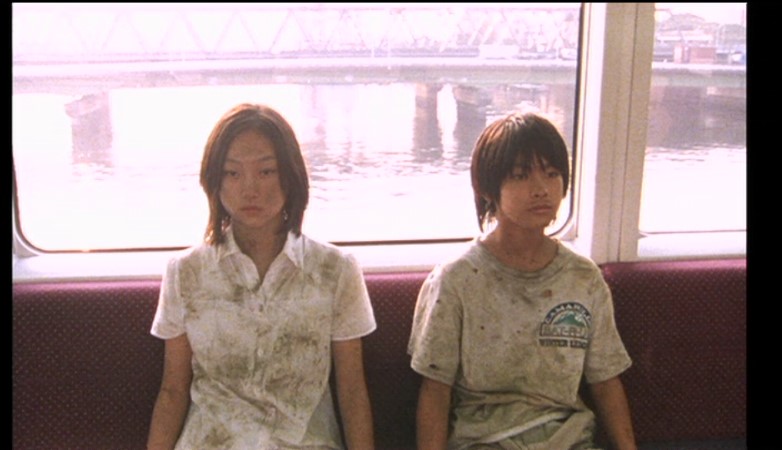
What makes someone a parent? Is it the fact that one is able to produce an offspring or is it something more than that? Nobody Knows (2004) try to explore the answer to that question and at the same time tries to show the stark reality of the effects of child abandonment in society and how it greatly takes away a big part of a child's life.
Based on a real life incident that happened in Japan, Nobody Knows is a story of the survival of four children after their irresponsible mother abandoned them. They are left to live on their own with the little amount of money that their mother left as she runs off and marry another guy.
Picture not mine. Click here for the original source.
It starts when a mother and son (12 years old) moves into a new apartment with their bulky baggage. As the door closes, two children pops out of the huge luggage while another one is rendezvoused at the train station and is stealthily sneaked in by her big brother. The mother then tells her children that they are not allowed to go out of the room and play nor go to school. She goes off after a few day leaving the eldest son, Akira, in charge with 50,000 yen which he is supposed to budget for the rest of the days until she is back. When cash was running out, Akira tries to ask for help from the fathers of his sibling but the attempt was futile. He was able to get 5000 yen from them and that's it. Fortunately, their mother comes back bringing presents for them. She leaves the next day never to return again, leaving the four children on their own devices.
It does not give you a resolution. It is merely a recounting of an unfortunate incident that befell four kids who are too unlucky to be born to useless parents who think that parenthood is nothing but a childish game they can leave anytime they want to.
Picture not mine.
Click here for the original source.
It surprises me that despite the movie's haunting theme and plot, I was numb after watching it. Usually, I would cry my heart out because of how cruel the world is to these kids but I guess it was the intention of the director to distance the viewer from the emotions, make it as stoic as possible, because the alternate option will absolutely be heart-crushing that one cannot help but question the morals of society and be jaded for the rest of his/her life. The scarier fact about it was that it was based on a real life story so if you step over the boundaries and attached yourself to the characters, you will feel a burst of emotions inside you: depression from the injustice of the situation, anger towards the irresponsible parents who had the nerve to forsake their children and despair from what we have let our society become.
Koreeda's brilliance lies on the fact that he was able to show the story in a subtle documentary-like story-telling that one will almost believe that these children are real, that their struggles are real and you cannot do anything but hold on to your seat and watch helplessly as the story unfolds. Yuya Yagira's portrayal of a 12-year old boy who tries to provide for his siblings while also struggling to fight for a chance to hold on to a childhood that was too early to be taken away from him was unnaturally superb. It was as if Yagira did not exist and what we can see on the screen is Akira Fukushima, the abandoned boy who only wants to have a normal life but left with no choice. He makes us forget about reality, sucks as in and brings us to this parallel universe where we are as powerless as he is.
This movie is not for people who can't stand the lengthy and slow pace that usually characterize Japanese films. It is slow and dragging, what with the 141 minutes of screen time where no action happens aside from conversations between the kids and multiple close-up shots of particular scenes to accentuate the harrowing situation that the children are in. But no matter how slow-moving or simplistic the movie is, it is never boring because each scene pulls you in to the characters' chaotic world and it rewards you with such severe humanism as you have never seen before.
The musical score adds up to the pulchritude of the film as it underlines poignant scenes in the movie such as Akira's and Saki's walk from the Haneda Airport after burying Yuri, Akira's frustration when he runs out of coins on the telephone booth without being able to talk to the mother that abandoned them, etc.
It is a good movie to watch if you are looking for something unconventional that will slap irresponsible parents out there with striking cold reality of the effects of child abuse. It earns my respect for Japanese films and it surely is a part of my highly recommended list.
Still Walking (2009) is a wonderful masterpiece from Hirokazu Kore-eda about the events that transpired in one whole summer day as the Yokoyama family reunites to commemorate the death of the eldest son who passed away 15 years ago.
It is a mirror of the dynamics between ordinary family members and the embedded flaws revealed from the snippets of conversation that occur all throughout the film. There's no huge arguments that escalated from the strained relationship of each family member. The confrontations are done in a natural manner, wherein instead of resorting to a major fallout, the tension is just exhibited in uncomfortable exchanges that last for a fraction of a second and immediately broken by awkward attempts to change the subject and ignore the issue. No overly exaggerated drama. No shouting. Nothing of that sort. It's just your typical day-to-day life projected on the big screen and it pulls you slowly and slowly until you realize that you and the characters are one and the same. The characters are so diverse that it is impossible for the viewers not to relate to at least one of them.
You have the old and retired patriarch Kyohei who is too proud and cold that he does not even care about how his gripe is affecting the family. He cannot move on with the death of his favorite son, Junpei, fifteen years ago, and this causes a strain between him and the youngest son, Ryota. Ryota, the frustrated and insecure art restorer is most affected by his brother's death that he can't even let himself visit his parents often and tries as much as possible to stay away from them. He has married the widow Yukari who has a son named Atsushi. The three of them were forced to visit Ryota's parents for Junpei's 15th death anniversary. Chinami, the middle child, is a cheerful mother of two who plans to move to her parents house with her husband Nobuo. She tries to ease the tension between the characters despite the chilly atmosphere that floats around the house.Another important character in the movie is the matriarch Toshiko, who may seem caring and warm at first, but is revealed to be despiteous towards Yoshio, the boy that her son saved 15-years ago.
The beauty of the movie lies on the fact that it is too close to home. It is too understated and simplistic but is careful not to cross the boundaries of catatonia. It is the poignant depiction of life, how we try to struggle to keep afloat despite the changing times; how we try to live and go on because time will never stop for us; how the wheels of existence keep on turning as we are put to alternating roles that were once seem unfamiliar to us. Moreover, it is a film about family ties; how we take for granted the smallest and simplest things and how we are reduced to words and promises that we never really keep.
The last ten minutes of the story is the true gem of the film. It seems to piece everything together and also contrasts the bitter reality that we have to face. The exchanges between the younger Yokoyama couple and their older counterparts are strikingly familiar to our generation. How the older ones yearn for more visits from their children and how the children resolves to avoid visiting their parents. It is a harsh reality but it is undeniably built on a solid foundation that we are well acquainted of. Ryota's recounting of not being able to see the soccer game with his father, never really being able to let his mother ride his car to go shopping and seemingly being too late for almost everything. It is not remorse. It is done in a matter-of-factly way that is too unnerving to really reflect on.
Again, Kore-eda has added another jewel to Japan's pride. Still Walking is part of my highly recommended list. It is not cathartic. It is not a feel-good movie. It is just a movie about life and the real meaning of our existence and funnily enough, it is a wonderful thing to behold.
Recently, I have started spending my spare time ( spells ALL THE TIME) watching films. Since, I am not doing anything productive and I just discovered the wonders of torrent, I decided to download (yes, I know it's illegal, sue me) films to make myself ignorant eyes/mind cultured in a way. The first film that came to mind was a Japanese film that my student recommended to me. It won the 2009 Academy Awards for Best Foreign Language Film. It was well worth it, probably one of the best films I have ever seen.
t starts with the story of a cello player whose orchestra got disbanded because of declining viewers/show-goers. Left with a huge debt for buying his cello, he decides to sell it, move to his hometown and start anew. His wife, who was a computer programmer, passively agrees with the decision in a move to "support" him. Back in his hometown, Daigo (the protagonist of the film) started scanning some classified ads in an attempt to find a new job. He found a job advertisement that said "Assisting people in their departures" and thought that it was a job posting for a travel agency.Desperate for work, he decided to go to the agency for an interview and was unceremoniously hired by the owner after asking him just one question " Will you work hard?" Daigo was very surprised that he was immediately hired and his shock grew more when the owner told him that he will earn 500,000 yen a month. Wondering about the true nature of the job, he asked the owner what the job description really was (suspicious as well, seeing that the office has a display of several coffins in a corner ). The owner answered that the agency dealt with the "departed" by conducting the encoffining ceremony for the funeral. Troubled by the job description, Daigo insisted that the job advertisement said it was about "departures" and the owner revealed that there was just a mistranslation in the job description. Hesitant at first but left with no choice, Daigo accepted the job and went home to find a surprised Mika (his wife) who asked him if he got the job. When Mika asked Daigo about what the job was, Daigo answered it was just for "ceremonies".
Daigo's first assignment is to pose as a corpse for a "company DVD" which is basically a guide to encoffinment. This DVD serves as a pivotal point in the story when Mika finds this object in Daigo's desk and leaves him because he refused to leave his job. Words began to spread about Daigo's job and people started to treat him as a pariah since most of the townsmen shun the topic of death. This view is further reinforced in a scene where he encountered his childhood friend who advised him to "find a decent job".
Mika returned to him announcing that she is pregnant and insisted that it should be a motivation for him to find a proper job. Daigo answered back but was cut off when someone called him to tell that the owner of the bath house where he used to go (the mother of that same childhood friend he met earlier) died and that he had to go to perform the encoffining ceremony. He obliged, bringing Mika with him. He lovingly performed the ceremony, even donning the old woman her favorite scarf before putting her in the coffin. After the burial, Mika and most of Daigo's close friends (including his childhood friend) began to understand his job and started to not view it innocuously.
The climax of the film happened when someone informed Mika about Daigo's father's death. Daigo was then left with a choice of whether to go and see his father's corpse or not, while still clutching on the grudge he felt for his father for leaving him when he was young. The story ends with Daigo coming to terms with himself and deciding to perform the encoffining ceremony. Daigo started to cry when he finds out that before his death, his father was clutching the stone that he gave him when he was little, proving that his father never stopped thinking about him even before death.
What I loved about the film: I think the main attraction of the film is the subtle realism that is embedded in the solid story that tells us about the inevitable end that each of us must have to face. Most of us, not only the Japanese society, find death as a taboo. I, for one, am scared to touch a dead person, associating them with "dirt" and "sickness". The film shows us a new perspective on death, how beautiful it can be and how goodbye, painful as it may be, is just the beginning of a whole new adventure in the "other side".
Each scene was poignantly made and one cannot help but shed tears as you watch each twist unfold while realizing how brittle our existence is. The music perfectly complements the story, causing us more unimaginable sadness which leaves us helplessly bawling even hours after the film. Joe Hisaishi proves once again why he is master of music as the main theme of the movie conveys to the viewers all of the messages that were left unsaid by the characters.
One of the interesting thing about the film is how it ironically poses thecharacter in a situation where he makes a living out of the dead. This paradox was tackled even deeply in the film with the death of the bathhouse owner and the scene where the cremator, who was her friend, admits how remarkable it is that he serves as the guard of the gateways between two worlds: the dead and the living. Funnily enough, it presents to us the harsh reality that we have known for so long and yet refuse to accept : WE ARE ALL BORN TO DIE. We have no choice but to welcome death in our arms and stop trying to evade it because whatever we do, it is something we cannot really escape. People die but we have to move on. (To be continued)
Want to hear the emotionally captivating them of Okuribito? Click here.
Just your ordinary girl trying to live an extraordinary life. A couch potato on weekends. A procrastinating OC on weekdays. A judgmental bitch most of the time.